Working deals
Renewals & health
The renewals table adds a health score per account and two risk cards derived from whatever you have filtered to.
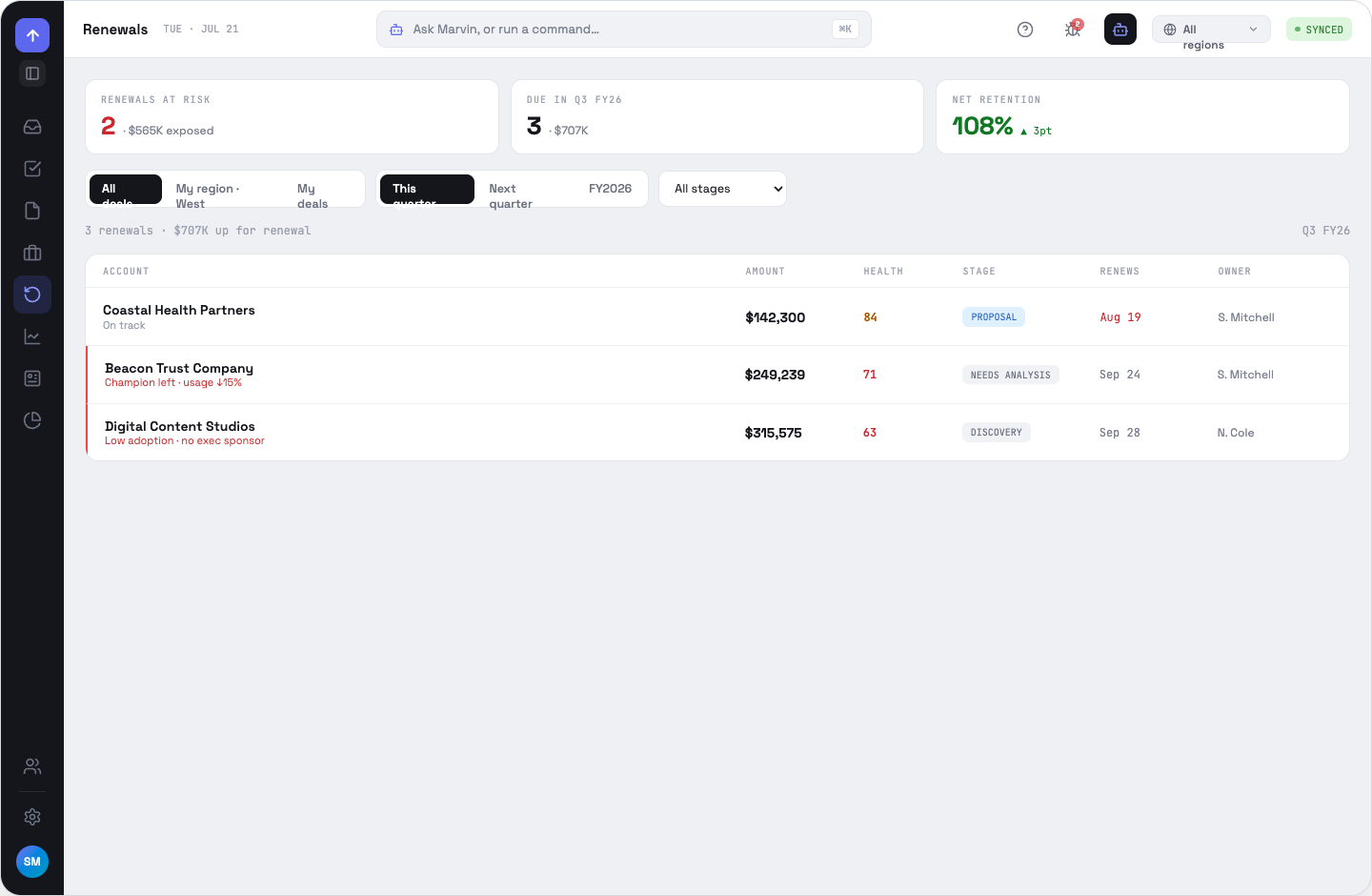
Reading a health score
The score is a weighted blend of the product-usage metrics an admin configured under External Data. Each metric carries a weight of ×1 to ×5 and can be excluded from scoring entirely. Bands are fixed:
The risk cards
The at-risk count and amount, and the “due in” card whose label tracks the period you picked, are both computed from the filtered rows. Narrow to My deals and they narrow with you. A deal counts as at risk below a health score of 75. The third card, net retention, is a placeholder — it reads — and is not yet tracked.
No usage data?
Health scores need at least one enabled metric with a date field mapped, under External data. Until then a row shows — when the account cannot be resolved at all — but an account that resolves with no usage rows rolls up to 0% and trips the at-risk rule, which is why the renewals table reads as uniformly critical on a workspace that has not configured a metric yet.
OppFlow.ai docs · by Traversal · v0.1.32